Everyday we experience the life through our five senses; touch, hearing sight, taste and smell.

The hardness of a rock, the sound of chirping, the sight of the blue ocean, the sweetness of an apple and the aroma of coffee are all example visual sensations that trigger nerve cells inside our sense organs. From there, signals are then passed towards the brain allowing us to make sense of them all. These kinds of sensations are all combined to create perceptions and that is how we understand the world as we know it.
The idea of the Gestalt effect was brought forth by psychologist Max Wertheimer which specifically refers to the visual sensations and perceptions. He is the man behind this important statement: "The whole is different from the sum of its parts." Wertheimer created five principles regarding the Gestalt effect called The Principles of Perpetual Organization.
Proximity:
When elements are sited close together, we tend to perceived them as a group.

Even though each object differ in size, shape, colour and etc, they will still be seen as a group due to their proximity to one another.
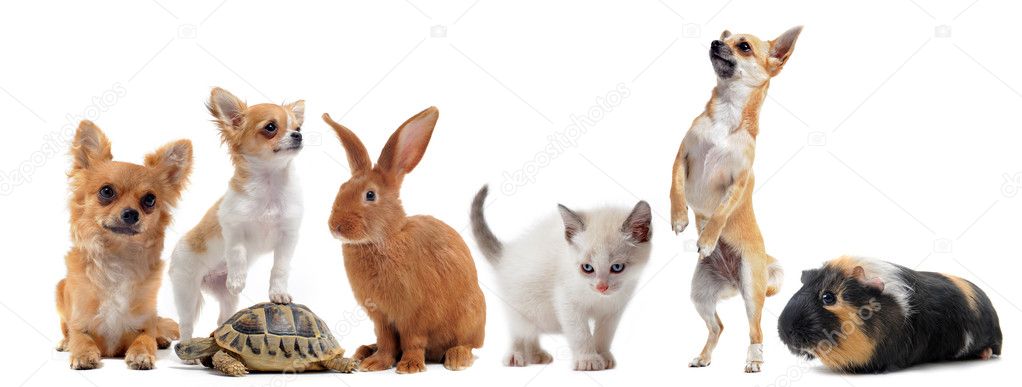

Objects that are grouped together can create illusion of familiar shapes, even without the objects touching.

Different shapes assorted together to form the letter U.

The illusion of a flower created by different shapes and colours.
Similarity:
We often notice objects that are alike to one another. In fact, we find pleasure in similarity especially as a mind-exercising game.

An example of a "Spot The Difference" game.

Is the dissimilar arrangement of the tiles bothering you?
So due to our quirk, we tend to group objects that are equivalent in size, shape, colour and etc.

Most people can see a triangle made out of 9 circles and a square made out of 33 squares.
(I can't help but feel that you will recount the number of squares, please do.)

We see columns of squares and circles rather than rows of square-circles because of their similarity in shape.
Common Fate:
This law refers to the theory that we see visual directions in text cognitively.
A viewer mentally groups five arrows or five raised hands pointing to the ky because they all point in the same direction. An arrow or a hand pointed in opposite direction will create tension, because the viewer will not see it as part of the upwardly directed whole. (Lester, 2006).
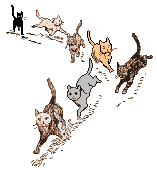
We can see where the cats are going.
Pragnanz (Figure/Ground):
The principle demonstrates our natural likelihood in distinguishing some figures from others in a whole text based on different features like colour, shape, size and form. The figure is the main text while the ground is the background.

Like the pun? There is an obvious difference between the "woman" and the "baby".

This picture can be of two individuals facing one another or a chalice or both.
When one or more things are the figure, the rest will be the ground. Hence it can change according the viewer's perception of which is the figure.
Closure:
As what the title says, we tend to 'close' up images even with missing objects. Our mind creates logic by thinking that the missing objects or gaps are part of the text itself hence creating a different whole.

We can see a rectangle, a circle and a triangle even without the lines touching.

You are being watched. Our brain creates logic by ensuring to us that this is an eye. However, the image is made of a circle and two crescents.
The Schema theory
Why do people view things as they do? Why isn't all text similar to what you and the rest of the world know?
Marvin Minsky (1927-Present) has said that when an individual encounters a new setting, he or she will select the closest possible memory called a Frame that relates to the foreign object.
We see things based on how we organize everything in our lives, for example people, settings, objects, animals, languages, systems and skills. This is all built by our personal experiences hence each schema will differ from one another.
This can be exemplified as me knowing more about my Kampong Pasai because I grew up there hence I have a more detailed schema of Kampong Pasai as opposed to those living further like Kampong Mentiri.
The Top-Frame and Lower-Frame
The Top-Frame of the text is always the ones that are true and the Lower-Frame contain many details or slots that can be modified.

The Top-Frame of a car are the tires, the windows, the doors and the spotlights.
The Lower-Frame are the colour, the design, what is it made of and so on.
Schema Congruity and Incongruity in advertisements
Congruity in an advert means that it is acceptable, friendly, familiar and has a lower congruity process.

As you might have guessed, incongruent adverts are strange, often controversial and acquires a higher congruity process.

References:
Spoken Falls Community College (n.d.). The Gestalt Principles. Retrieved September 15th, 2012 at http://graphicdesign.spokanefalls.edu/tutorials/process/gestaltprinciples/gestaltprinc.htm
Desktop Publishing (n.d.). Gestalt Principles. Retrieved September 15th, 2012 at http://facweb.cs.depaul.edu/sgrais/gestalt_principles.htm
Lester, P.M. (1995). The sensual and perceptual theories of visual communication. Visual communication: Images with messages (pp.52-58). California: Wadsworth Publishing.


